ChatGPT Ads are sponsored placements that appear at the bottom of ChatGPT responses for logged-in adult users on the Free and Go tiers. Launched in the US on February 9, 2026, they're now live in seven countries — and Spain isn't one of them. Targeting works through plain-language "context hints" describing what users are discussing, with full conversion tracking now available via OpenAI's JavaScript Pixel and Conversions API (both shipped May 5, 2026). Minimum spend dropped from $200,000 at launch to effectively $0, with CPMs reportedly between $15 and $40 depending on category. For Spanish brands — and any agency with LATAM clients — the window to learn the channel before it opens at home is right now.
Every decade or so, a new ad surface appears that genuinely changes how brands reach customers. Google AdWords did it in 2000 by monetising search intent. Facebook Ads did it around 2012 by monetising social graph data. ChatGPT Ads has the potential to be the third — by monetising conversational intent. Whether it lives up to that potential is still being tested in the open. What's not in doubt is that something genuinely new is happening, and the brands paying attention now will have a structural advantage when this lands in Spain.
What ChatGPT Ads actually are
A ChatGPT Ad is a sponsored placement that appears at the bottom of an AI-generated response, clearly labelled as sponsored and visually separated from the answer itself. According to OpenAI's own announcement, ads "do not influence the answers ChatGPT gives you" and the matching happens between the advertiser's submitted ad and the topic of your conversation, your past chats, and prior ad interactions.
In practice, the experience looks like this:
Illustrative example. Real ads are clearly labelled "Sponsored" and visually separated from ChatGPT's answer.
The format is deliberately conservative. Only logged-in adult users on the Free and Go tiers see ads — Plus, Pro, Business, Enterprise and Education subscribers do not. Ads also won't appear near sensitive topics, and users have controls to dismiss ads, share feedback, or delete their ad data entirely.
Where ChatGPT Ads are live in June 2026
The rollout has been fast. Four months from US launch to seven live markets — with two more announced and pending. Here's the current map (based on what's actually selectable in Ads Manager as of late June 2026):
Sources: OpenAI, Adweek, Digiday (May 2026). Mexico and Brazil were announced on May 7, 2026 but have not yet appeared as selectable markets in live advertiser accounts as of this writing.
Spain — and the rest of the EU — is conspicuously absent. The reason isn't technical; it's regulatory. The EU's combination of GDPR and the AI Act creates compliance complexity that OpenAI has chosen to address by launching in less-regulated markets first. Industry analysts expect EU rollout in H2 2026 or into 2027, though no official date exists.
Why this is different from Google and Meta
Most agency conversations about ChatGPT Ads start with the wrong question: "How does it compare to Google CPCs?" That framing misses what's actually new. ChatGPT Ads aren't competing with search ads — they're a different category of ad surface entirely.
| ChatGPT Ads | Google Search | Meta (FB/IG) | |
|---|---|---|---|
| User intent signal | Full conversation context | Single search query | Demographic + interest |
| Targeting options | Country + context hints | Keywords, location, audience | Demographic, behavioural, lookalike |
| Attribution & pixel | Pixel + CAPI (live May 2026) | Mature | Mature |
| User mindset | Active problem-solving | Active intent | Passive scrolling |
| Audience scale | ~900M weekly worldwide | Massive | Massive |
| Maturity | Early pilot (Feb 2026) | 26 years | 15 years |
| Best used for | Reach & brand discovery | Direct response | Awareness & remarketing |
The honest read: ChatGPT Ads in mid-2026 is still maturing as a performance channel — but it's getting there fast. OpenAI shipped its JavaScript Pixel and Conversions API in May 2026, so conversion tracking now exists in the same dual-track model Meta and Google use. The reporting infrastructure is younger and the lag is longer (about seven hours from event to dashboard), but the foundations are real. What sets it apart is the audience signal: a user actively explaining their problem in natural language, often with surprising specificity about budget, preferences, and constraints — something the older platforms simply can't match.
The numbers from the first four months
Reliable performance data is still scarce — OpenAI restricts what advertisers can publish about ROAS during the pilot. But what's been confirmed publicly tells an interesting story:
Sources: Digiday / AdClarity, Adweek.
A few more verified data points worth knowing:
- CPMs have dropped sharply — from around $60 at the US launch in February to a reported $15–40 range by April, depending on category.
- Minimum spend went from $200,000 to $0 in three months. When ChatGPT Ads launched, it was an enterprise-only pilot. As of May 5, the self-serve Ads Manager opened to all US advertisers with no floor.
- VistaPrint reported that the majority of ChatGPT-driven traffic was new visitors — not existing customers, not retargeting. This is one of the most consistent signals from early advertisers: ChatGPT Ads reaches people the existing channels miss.
- Best Buy, Lowe's, and other major retailers have publicly confirmed they're testing.
- Impression volumes grew ~600% from early March to mid-March alone, as inventory expanded.
The metric to watch isn't CPM or CPC right now — it's "share of new audience". The most consistent signal from early advertisers is that ChatGPT Ads is reaching customers who aren't already in their Google or Meta funnels. That's a different kind of value than what most performance dashboards measure. If you're a Spanish brand that's hit a ceiling on Google and Meta acquisition costs, this is the strategic story to track — not the unit-economics one.
What targeting actually looks like
This is where the platform diverges most sharply from what marketers expect. As of mid-2026, ChatGPT Ads offers two targeting levers — and that's it:
- Country-level geography. One campaign per country. No state, DMA, postcode or city targeting outside the US (which has limited geo granularity).
- Context hints. Plain-language descriptions of when an ad should appear — describing relevant query types or topics. Not exact-match keywords, more like "show this ad when someone is researching meal kits, dinner ideas for couples, or weeknight cooking."
What's not available: demographic targeting, behavioural targeting, interest categories, retargeting audiences, lookalike audiences, or any of the granular audience controls that have defined Meta and Google for the last decade. OpenAI is deliberately building an ad platform without the third-party user-tracking infrastructure that defines its competitors — partly for trust, partly because conversation context is rich enough on its own. The new Conversions API exists for measuring outcomes, not for building targeted audiences.
For agencies and advertisers used to performance dashboards, this is a real adjustment. For brand marketers used to measuring lift, recall, and category awareness, it's surprisingly familiar territory.
Conversion tracking: pixel and Conversions API are now live
For the first three months of the pilot, conversion measurement was ChatGPT Ads' weakest spot — and the main reason performance marketers stayed on the sidelines. That changed on May 5, 2026, when OpenAI shipped both a JavaScript Pixel and a Conversions API, bringing ChatGPT Ads in line with the dual-track measurement model Meta and Google use today.
JavaScript Pixel (browser SDK)
A browser-side SDK loaded from bzrcdn.openai.com/sdk/oaiq.min.js. Initialised with your Pixel ID from Ads Manager, dropped into the <head> of your site, then fire events with oaiq("measure", eventName, props) on conversion pages. Captures the oppref parameter from ad click URLs and stores it in a first-party __oppref cookie (30-day lifetime) to link conversions back to specific ad clicks.
Conversions API (server-side)
Server-to-server endpoint at bzr.openai.com/v1/events, authenticated with a bearer token from your Ads Manager. POST batches of up to 1,000 events. Catches the 20–30% of conversions the browser pixel loses to ad blockers, browser tracking prevention (ITP), and consent declines.
The two systems are designed to work together. When you fire the same conversion from both the browser pixel and your server, you pass a shared event_id, and OpenAI deduplicates them on the tuple (Pixel ID + event name + event_id) — exactly the same pattern as Meta CAPI. OpenAI itself recommends running both for accuracy.
A few more practical specs to know before you start:
- Eleven standard event types supported out of the box (page view, order created, lead, sign up, etc.), plus custom event names.
- Reporting lag is about seven hours from event firing to Ads Manager dashboard — don't assume your tracking is broken if numbers don't show up right away.
- Open-source Google Tag Manager templates have already shipped from Stape and TensorOps under Apache-2.0, so most teams won't need to hand-code the install. A web GTM template for the pixel, a server GTM template for the Conversions API — both with built-in event-ID deduplication.
- Consent compliance is built into the Stape and TensorOps templates via Google Consent Mode hooks, which matters for any future EU/Spain rollout.
This is the biggest change to ChatGPT Ads since launch, and most agencies running campaigns haven't fully caught up yet. Until May 5, you literally couldn't measure ROAS on this channel — now you can. The brands that set up clean Pixel + CAPI tracking now will have a measurable advantage when the channel scales. Our recommendation: start with the pixel via the Stape GTM template (about ten minutes), then layer the Conversions API once spend is meaningful enough that the pixel's 20–30% blocker loss actually matters to your numbers.
Pricing and access in mid-2026
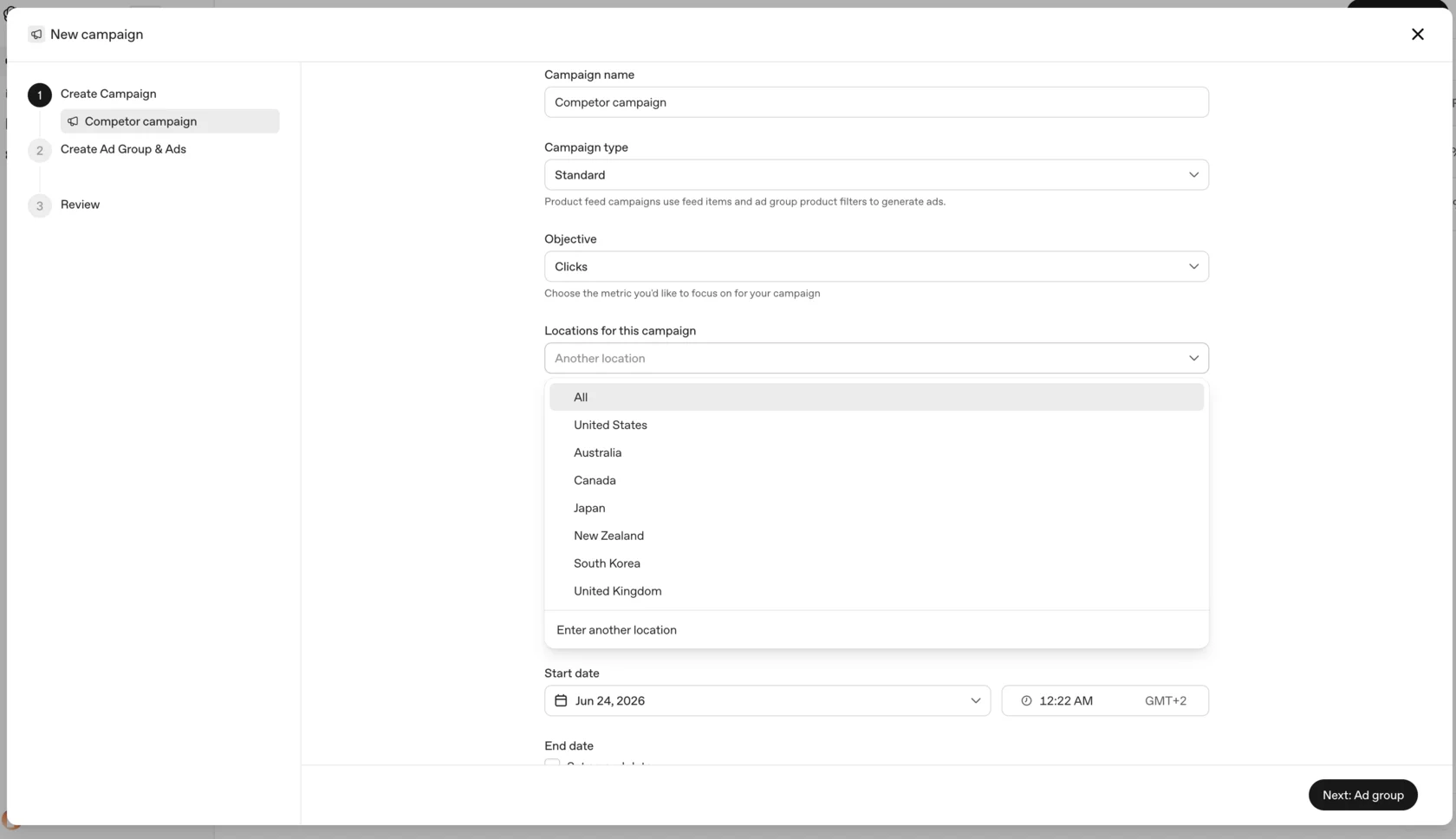
The path to launching is now straightforward in the live markets: sign up at openai.com/advertisers, get vertical eligibility approval (some regulated categories are restricted), submit creative, set context hints and budget, and go live. The whole process can move in days, not the weeks it took during the early pilot.
What we've learned running ChatGPT Ads
[Editor's note: this section is a placeholder template — replace with your own observations from live campaigns. Below is a structure based on the strongest patterns from public agency reports and our own early testing.]
From the campaigns we've been running for clients in markets where ChatGPT Ads is live, four patterns stand out clearly:
oppref attribution model still benefit from being paired with GA4 tracking, UTM tags, and a "how did you hear about us?" survey on the post-purchase page. We layer all four for maximum confidence in the numbers. The honest limitations
No new ad platform is without rough edges, and ChatGPT Ads has a specific set worth naming:
- Tracking is new and still maturing. Pixel and Conversions API only shipped on May 5, 2026 — most agencies haven't fully set them up yet, and the seven-hour reporting lag means you can't make intra-day optimisation calls. Treat the data as directionally accurate, not real-time.
- No granular geo or audience targeting outside the US. For multi-market planning, each country is effectively its own campaign with limited optimisation levers.
- Restricted verticals. Sensitive categories (pharma, financial services, gambling, political) face restrictions or are excluded outright.
- Pilot-stage pricing is volatile. CPMs have already dropped from $60 to $15–40 in four months. Whether that floor holds as inventory tightens with broader rollout is unknown.
- EU/Spain timing unconfirmed. No public commitment on when the European market opens. Brands planning around a Q3 or Q4 2026 launch are speculating, not planning.
The right framing isn't "should we run ChatGPT Ads now?" — it's "what would we need to know about this channel by the time it opens in Spain?" Answering that means doing the work now, in markets where you can.
The Spain opportunity is in the preparation
Here's what most Spanish brands are getting wrong: they're waiting. The assumption is that you can't do anything useful about ChatGPT Ads until it launches at home. That's not quite right. The brands that move fastest when Spain opens will be the ones that have already:
- Tested creative formats in adjacent markets — the UK is the most accessible English-speaking option for an EU-facing brand, and Mexico/Brazil will be particularly relevant once they actually go live.
- Built a measurement framework on the new Pixel + Conversions API, with proper event-ID deduplication.
- Learned how to write context hints for their category — a skill closer to copywriting than to keyword research.
- Understood their incremental audience on this channel versus Google and Meta.
- Established compliance posture for the GDPR and AI Act implications that will come with EU rollout.
The Mexico angle worth tracking carefully. OpenAI announced ChatGPT Ads expansion to Mexico on May 7, 2026, alongside Brazil, the UK, Japan, and South Korea. As of late June, the UK, Japan, and South Korea have actually become selectable in advertiser accounts — Mexico and Brazil have not yet. When Mexico does go live (expected H2 2026), it becomes the natural staging ground for any Spanish brand running paid acquisition into Latin America. Creative, context hints, and measurement playbooks built in Mexico translate almost directly to a Spain launch when the EU finally opens. For Spanish agencies with LATAM clients, this is the highest-leverage market on the announced list.
All of this is possible right now — for Spanish brands with international reach, or through campaigns run from agency entities in the seven live markets. The brands that wait for the home market to open will be six months behind on day one.
Frequently asked questions
Marvelsy Service
We're already running
ChatGPT Ads.
Most agencies in Spain are still figuring out what ChatGPT Ads is. We've already been building campaigns, testing creative formats, and learning the measurement model in the live markets. When Spain opens, our clients won't be starting from scratch.
First call is free. No commitment, no slide decks — just a conversation.
